Monday, December 15, 2014

Manage Time, not Results! 2697.1 to 2715.3 Miles: 12/15/14


Buy on Amazon
Virtual Hike
Animated Street View
Today's Weather
Entered North Dakota
Completed Segment 40

Route 12 has wide shoulders in Montana, but they are narrow in North Dakota. It doesn't look like there is much traffic.

There is a small convenience store in Mamarth, ND about halfway through these legs. 

Buy On Amazon


Entered North Dakota


Forward Planning and Progress Monitoring


Introduction

Most people use deadlines to determine if they are completing a task on time. If they are writing a book, they plan time slots for each activity such as research, outlining, writing, proofreading, etc. Experienced writers know how long it takes to write a book and they may hit these deadlines closely. But what happens when they get ahead of schedule? Do they take some time off or continue working as hard. There is a trap in deadline planning that ensures many projects will be late.

Forward Planning

When I was in the Air Force, I'd sometimes go on six week deployments overseas. At the beginning of the deployment, they would advance us $25 a day to buy food. It was a long time ago, so $25 was enough.

Each day, I counted my money to determine how much I could spend a day during the rest of the deployment. This is planning by looking forward.

Children plan forward when on vacation. Did you ever hear a kid ask, "How long have we been traveling?" No, they are interested in when they will get to the destination. 

If someone is driving to catch a plane, do they ever ask how long they have been driving? No. They are doing a series of calculations to determine when they will reach the airport. Most people plan a buffer to arrive in plenty of time for parking, check-in, screening and boarding. 

Forward looking planing can help avoid the "deadline trap" that ensures many projects will be late.

The Deadline Trap

Take the case of driving to the airport. They decide to leave 30 minutes sooner than needed to allow for delays. Suppose the traffic moves quicker than the person anticipated. They have an extra 15 minutes and decide to stop for a fast-food breakfast. The line is longer than they anticipated and it takes them 25 minutes to make the stop. Then they get a few lights against them and they have eaten into 30 minutes of their buffer. Now, instead of being early, they are late. The line at the check-in counter is longer than expected. They are asked to step aside at screening. Then they have to run all the way to the last gate. As they arrive at the gate, the door of the plane is closing and they missed their flight.

4 x 440 Relay Race

This is important enough to warrant another example. It is inspired by "The Critical Chain" by Eliyahu Goldratt and "The Project Manifesto" by Bob Newbold and Bill Lynch. 

Compare a project to a 4 x 440 relay race where each runner will run one lap. The goal is to complete the four laps in four minutes.

The first runner runs their lap in 55 seconds. Instead of passing the baton, they weight until 60 seconds to pass the baton. The second runner runs their lap in 65 seconds and passes the baton.
The third runner runs their lap in 53 seconds and again waits until 60 seconds to pass the baton. The fourth runner runs their lap in 60 seconds. Total time: 4:05.

Everyone looks at the slow runner and blames them for missing the goal. Is that really what happened? Of course not. But this is what happens with deadline planning.

Deadline Planning Negates Early Finishes

When people meet a deadline, they often don't pass on the project to the next step. If they did, they would get a shorter deadline the next time. Meanwhile, they would get extra work to do.

The normal way of planning is to give a safety buffer at each phase of the project. The Critical Chain way is to put the buffer at the end. The project manager monitors when the project will be done, not how far it has progressed. Since the baton is passed as each phase is complete, it should run ahead of schedule on most projects.

Practical Application

At the start of a project, estimate the exact FOCUSED time in hours it will take to complete the project with zero delays. Add a 20% buffer to the ENTIRE project and have no buffers to the individual steps. Track the FOCUSED time spent on the project. Do not panic until you've used up 10 to 15% of the buffer. 

48 State Hike Application

The walker will have to average 24 miles a day which should take about 7 hours at walking pace. Instead of tracking miles each day, track the hours at walking pace. This will keep the benefit of good days which will offset the bad days. About once a week, determine how many hours a day are needed to arrive on time.

Conclusion

Tracking a project by time instead of progress is a new concept to many. Try it on something non-critical like house cleaning or yard work. I've been using this method for a couple years and it does help me complete projects quickly.


Sunday, December 14, 2014

Planning away the Fears 2656.3 to 2697.1 Miles: 12/14/14


Buy on Amazon
Virtual Hike
Animated Street View
Today's Weather

I thought we were done with the long stretches between services, but I was wrong. It's 79 miles from Miles City, MT. to Baker, MT.

I suggest taking a rest day in Miles city and possibly Baker. 


Buy On Amazon

Since this part of the route is in the end of June, it also has the potential of being hot. 

At least the road has a wide shoulder all the way. By this time, the walker should have a good idea how to handle this stretch. Depending on how I felt, I'd plan to hike a good part of the second day before sunrise. 

Cold morning

Planning out the Fears


Introduction

This post will focus on the planning that happens after the route is deemed to be generally walkable. The purpose of this planning is to add details that will plan away the fears. It will include food, water, navigation and motels.


Why Plan away Fears?

Backpackers say people carry their fears. If a person is afraid of running out of water, they carry too much water. If they are afraid of running out of food, they carry too much food. If they are afraid of getting lost, they carry too many maps and guide. If they are afraid of finding a place to camp, they stop too early. Most fears are unfounded and can be planned away.


24 Mile Segments

The walker will have to average 24 miles a day to make the trip in a year. Therefore, I'm zooming in on 24 mile segments. I'm adding supermarkets and motels in this pass through the route. The supermarkets are close enough together that the walker can take enough water to make it from one to the next in most cases. In the next pass through the route, I'll add gas stations and other water sources if necessary.

When person has a large task, it helps to break it into small tasks and focus on one task at a time. I'm creating a map and written guide for each 24 mile segment. 

Here is an example: (I can't show a map because of copyright limitations. I'm using Microsoft Streets & Trips 2013 to plan the hike.)

Notice I added navigation points to the route as it passed intersections or other landmarks.

DAY 1

Mile
Instruction
Toward
0.0
Depart Arby's [719 W US-50, Pueblo CO 81008, United States, Tel: +(1)-719-5437750] on US-50 [W US-50] (West)

7.1
Turn RIGHT (North) onto N McCulloch Blvd

7.3
At Walmart Supercenter [78 N McCulloch Blvd, Pueblo CO 81007, United States, Tel: +(1)-719-6479861], stay on N McCulloch Blvd (South) (Consider skipping this one.)

7.5
Turn RIGHT (West) onto US-50 [W US-50]

9.0
At 9.0 Pass W. McCulloch, stay on US-50 [W US-50] (West)

12.6
At 12.6 Miles Cross Turkey Creek, stay on US-50 [W US-50] (North-West)

18.2
At 18.2 Miles Pass 120, stay on US-50 [W US-50] (West)

22.4
At Cross L Street, stay on US-50 (West)

24.0
Arrive 24 Miles End day 1


End of day


DAY 2

Mile
Instruction
Toward
24.0
Depart 24 Miles End day 1 on US-50 (West)

24.7
At 24.7  pass Exit to 115, stay on US-50 (West)

29.1
At Cross 67, stay on US-50 (West)

32.8
At Cross County Road 168 (Macknzie Ave), stay on US-50 [E US-50] (West)

35.4
Turn RIGHT (North) onto (E) Main St

35.4
Turn LEFT (West) onto (E) Main St [Main St]

35.5
Road name changes to Main St

35.6
At Safeway [1414 Main St, Canon City CO 81212, United States, Tel: +(1)-719-2755221], stay on Main St (West)

35.6
Turn LEFT (South) onto S 14th St, then immediately turn RIGHT (West) onto US-50 [W Royal Gorge Blvd]

37.2
At 37.2 miles Start turn north on 50, stay on US-50 [Gold Belt Tour Scenic and Historic Byway] (West)

39.9
At Pass Skyline Dr., stay on US-50 [Gold Belt Tour Scenic and Historic Byway] (North)

40.5
At Pass County Road 69, stay on US-50 [Gold Belt Tour Scenic and Historic Byway] (North-West)

44.4
At Pass County Rd. 3A, stay on US-50 [Gold Belt Tour Scenic and Historic Byway] (West)

45.6
At Pass Route 9, stay on US-50 [W US Highway 50] (West)

47.3
At 47.3 miles Cross Arkansas river, stay on US-50 [W US Highway 50] (West)

47.9
Arrive 48 Miles End Day 2


End of day


Eventually, I'll publish a new virtual hike with all the information. 

Long Process

This process takes a long time and few people do it on a road walk. Many plan on the fly and hope they make it. Their opinion is if they change their route all the planning was for nothing. My opinion is get back on the route when possible if a change is needed. If the walker has all the information, they can walk more and plan less on the road.

Conclusion

Detailed planning removes uncertainty and removing uncertainty removes many fears. The trick is to make the plan detailed enough and not too detailed. 

Thursday, December 11, 2014

Don't Blow-up your Goals!: 2634.8 to 2653.6 Miles: 12/11/14


Buy on Amazon
Virtual Hike
Animated Street View
Today's weather

The route continues along Route 12 in eastern Montana. The road has wide shoulders. There are some places for stealth camping. I don't see a fence along the side of the road.

Consider walking many of your miles before sunrise. This is the type of road where you can see headlights for miles. In a future post, I'll explain how to get two days of walking into one day with no added fatigue


Don't Blow-up your Goals!


Introduction

This week I had an opportunity to blow-up my goals. I tried to increase my mileage more than reasonable and it wasn't working. What have you observed others do in similar situations when they raised their weekly goal too much?

What happened?

I decided to increase my weekly miles from 86 miles to 92 miles.  I thought this was reasonable as I've walked 98 mile weeks before. 


On Monday, disaster struck. Something happened that legitimately stopped me from walking the miles. 


No problem, I thought. The system was designed to make up miles later in the week. It worked on Tuesday when I made up a couple of miles.

However, I realized if I continued trying to make up miles during the week, I'd become fatigued and not able to complete the goal next week. There were a couple options. I could accept the short day and not meet my goal this week. I could gradually try to make up the miles over a couple of weeks. That might have worked, but....

The System Blew Up!

Why did the system blow up? I was behaving like a person who budgets only for expected expenses. When the expenses are less than expected they frivolously spend the extra money. When the expenses are more than expected, they put the extra expense on their credit card.

I failed to create a "rainy day fund" of extra miles. There wasn't a good opportunity as this is only the second week of attempting to walk 10 million steps in 12 months. 

How did I fix it?

I used the saying, "If you don't hit the target, then move the target!" That way I get perfection every week as perfection is defined by what I accomplish. On the surface, it sounds crazy, but I'm crazy, so let's see what I did.

All I did was reduced the goal for the week until I could meet the goal without walking any extra miles the rest of the week.

As it turned out, the new goal increased my mileage from last week, so I still came out ahead.

Now, I'm starting to gradually build a contingency reserve which points out another error.

In the past, when I walked a few tenths of a mile extra in a day, I walked less the next day. Now I'm carrying the extra miles forward until I need to use them.

Aim High for Success Failure

The same books that tell people to aim high for success often tell people to make goals attainable and realistic. Attainable and realistic implies certainty. The key to success is not aiming high. It is improving the process that allows a person to realistically achieve a higher goal with certainty instead of luck.

Conclusion

This week reminded me to focus on the two things that will blow up a 48 state reality hike: fatigue or injury. Either one of these can force a long break that can last weeks. If I start to feel fatigue or an impending injury, I'll reduce my weekly goals even though it means I won't complete the hike. Randomness happens both ways, so most likely it will eventually work in my favor. 

What usually happens with long-distance hikers is they get their trail legs and start walking more miles than they dreamed possible.  After reading many journals, I realize they improve their process and use the extra energy for miles instead of doing other things.


Tuesday, December 9, 2014

Predictability Equals Success: 2585.3 to 2634.8: 12/9/14

This is 3 1/2 days of reality walking and six legs of the hike. I've delayed posting as I've been testing and pondering the effects of predictability - or variance as mathematicians would call it.

Buy on Amazon
Virtual Hike
Completed Segment 39
Animated Street View

The route follows some back roads near Miles City in eastern Montana. The animated street view will stop as it goes through the parts that are dirt. 

Reynold's Market is on the route into town and looks like an awesome place to shop. There is a motel on the route on the way out of town. Call ahead to avoid extra miles.


Predictability Equals Success


Introduction

I've been reading Eliyahu Goldratt's books about ways to make businesses successful. In his first book, "The Goal: A process of ongoing improvement" I learned you can find the weak spot in any linear process by looking for the bottleneck. In his second book, "The Critical Chain: A Business Novel," I learned that a project has a higher chance of being completed on time, on budget, and on quality if people are held to their predicted completion times. Variances are tightly controlled as if they get off track, resource competition occurs. (Ex: Two people need the hammer at the same time.) In his third book, "Isn't it Obvious!" I learned inventory must be tightly controlled for retail stores for maximum profitability. 

In all of these books, I learned that delivering a steady stream of product is better than delivering in large batches, even if it costs more. 

I'm drawing from all of these and from personal backpacking experience to show why predictability, and not extra miles walked each day equals success. This seems to transfer to every field.

Constraint Stacking

When I planned this virtual hike, I started with a route. The first goal was to see if I could physically walk the route. The second was water availability. The third was food availability. I also planned to stay away from big cities and to hike during reasonable weather. I think all of these are resolved under one condition. The walker travels at a predictable pace. It almost doesn't matter what the pace is as long as it is predictable. Each time the food and water constraints are replenished, it starts the clock again. If the walker wants to take a rest day, this is most likely where they should take it.

Tight Scheduling

I haven't done it yet, but I know this hike can be tightly scheduled. Why is this important? What needs to be scheduled?

The cause of staying on schedule is the walker hiking the planned miles each day. This is the drumbeat for the whole operation. Not only should they hike the planned miles each day, but internally, they should plan the miles for each part of the day. Why?

The reason why is predictability and flexibility. As long as the plan is working well it is easy, but if it changes, the walker needs to know what changes are possible. They will get this experience from following a plan. For instance, suppose they are delayed by a thunderstorm. Do they hike farther that day or do they spend the night? 

This problem is at least partially resolved by a sawtooth walking schedule. Walk long miles the first day out from a constraint and short miles on the way into it. For instance, if the next water is 40 miles away, walk 30 miles the first day and 10 miles the second. 

Small packages

Each of Eliyahu's Goldratt's methods involves breaking large projects into smaller packages. The walker should plan as many places as possible along the route where the constraints of food and water are satisfied. They should replenish to the smallest amount of food and water they need until the constraints can be satisfied again. This may mean stopping more often for food and water, but it also means pushing less weight. Balance this against the distance a grocery store is from the route.

Practice the method

If you are like me, right now you may be a bit confused about what the process is. There is no need to take a long trip to learn the process. You can find five grocery stores in town and plan a hike to all five in one day. Stop in each one and touch the items you would need for a reality hike. Try to arrive at the grocery stores at a specific time. That timing is what you are practicing.

Conclusion

As I said, I'm at the edge of understanding why predictability is more important than the number of miles traveled each day. I do know that as I've made my goals more stringent, I've been averaging about 50% more miles a day than before. I also find that as I become more predictable, I have an easier time winning pedometer wars. For now, sit on the concept without objections. I'm not saying do it my way. What I'm saying is consider how predictability may help and if it doesn't, don't worry about it. 


Friday, December 5, 2014

Implementing the Theory of Constraints: 2562.2 to 2583.3 Miles


Buy on Amazon
Virtual Hike
Segment 39 Map
Animated Street View

The route is in eastern Montana. There is an error in the plan. The route will need to go into Forsythe, take a frontage road near Interstate 94 and go north where the 94 is on the map. Go north to intersect the planned route.

The road is narrow and old, but there isn't much traffic.


Buy On Amazon


Implementing the Theory of Constraints


Random Ball in the center median

Introduction

The goal of the training phase is to deliver a body capable of averaging 24 miles a day to the start of the 48 state hike. This is no different than the goal of a production process being to deliver 24 units of a product on a given date. 


There are five steps to the Theory of Constraints Process.

  1. IDENTIFY the system's constraint(s)
  2. Decide how to EXPLOIT the system's constraint(s)
  3. SUBORDINATE everything else to the above decision
  4. ELEVATE the system's constraints.
("The Goal: A process of ongoing improvement." Eliyahu Goldratt)

Let's look at these one at a time.

Do you see the moon?

IDENTIFY the system's constraint(s)

Yesterday, we determined the time available to train is the constraint for the training phase. There are many ways to find time in the day and I will leave that as an exercise for the reader. Don't do it right now. After you learn this process, consider time as a product and work backwards to find the constraint and go through the process.


Decide how to EXPLOIT (UTILIZE) the system's constraint(s)

Once you have found the time, it is essential to use the time efficiently. This means having the best training plan you can devise. Don't delay training to find the best plan. You can start with something simple like walk for a half-hour each day. Let's use this for the starting plan because it makes the later explanations easier.

SUBORDINATE everything else to the above decision

Once you set aside a half-hour each day, make that time untouchable for anything. Even if training is not the most important thing in your day. Even if it is the LEAST important thing in your day. 

A surprising thing happens when doing this. Everything else in the day becomes more efficient. Let's say the half-hour is during the lunch break. You will do everything before lunch more efficiently because if you don't, you miss your half-hour. You will do everything after lunch more efficiently as you have limited your time. 

When time is limited to the least amount needed to do a job, then people tend to work more efficiently.

ELEVATE (Utilize) the system's constraints

Translation: Use the time in the most efficient way.

Make sure you use the entire half-hour. One time I was on a six-week business trip to Minneapolis. It was the type of thing where everyone wore suits or similar clothes for women. We had an hour for lunch. We  walked briskly to the food court in the nearby mall to get something to eat. Since the lines were long in the food court we wasted time in line. Then we gobbled down our food and walked briskly back. We arrived back in the classroom for about 15 minutes early and talked. The total walking time was about 20 minutes.

Nobody complained we were walking in business clothes. Nobody warmed up before walking. Nobody insisted on taking a shower before returning to class. Could these we have worked a half-hour of brisk walking into this lunch hour and still had time to spare?

Why certainly! If a person wanted to, they could bring their lunch. They could leave the classroom, walk for a half-hour in the mall and return to the classroom after a half-hour. Then they could eat their lunch during the remaining half-hour.

There is no need to stretch before walking. You might have to start at a slower pace, but stretching exercises are unnecessary for most. There is no need to walk in athletic clothes. Nobody wears athletic clothes to walk to a bus stop. 

Second Iteration

Once you get to where you can walk a half-hour each day, what's next? Time again becomes a constraint and you need to find more of it!

Let's use the same lunch hour.

How long does it REALLY take to eat a sandwich you bring from home? Maybe 10 minutes, that's all.

There are five hours of lunch during the week. You could theoretically use all five of them for walking, but it would probably leave a new walker sore and tired. I propose a different plan.

50, 45, 40, 35, 30

The order is important, but not for the reason you might think. It's important from a training perspective, not from "the student paper" perspective.

When I look at this, I say, "Great, if I miss time early in the week, I can slip the miles until later in the week!" If this is done, at best the walker will find themselves walking 40 minutes each day. At worst, they will need to find time to walk 200 minutes on Friday.

I'll explain more about this in a later post, but for now, if you miss the goal one day, skip the day. If you want to walk more on the last day because you feel good, do not. It has a ripple effect through the whole training program.

Don't do it my way!

This example was to illustrate the process of the Theory of Constraints, not to dictate an answer.


Conclusion

This process will apply to any task from walking, to finding time to making blog posts to spending time with your family.

There is a saying among the Jewish people that learning without doing is like a load of books on an ass. I say there is no learning without doing, so don't waste time reading if you don't intend to implement at least part of what's in the reading. Napoleon Hill says there is no learning without teaching. 

If anyone decides to test this theory, I'd appreciate it if you leave a comment about how it worked.


Thursday, December 4, 2014

Theory of Constraints: 2554.1 to 2562.2 Miles: 12/4/15


Buy on Amazon
Virtual Hike
Animated Street View
Today's Weather
Completed Segment 38

The route follows Route 12 in eastern Montana. The first few miles have a narrow shoulder, but then it gets wide.

The route is a little hilly with a few trees.
Buy On Amazon

There aren't any apparent places to stealth camp, but there shouldn't be a need as Forsyth isn't far from the end of this leg.


Current Planning Status

Now that I've walked 2,566 miles while pondering the challenges of a 48 state reality hike or virtual hike, I'm close to a solution. I have to resolve minor issues for a reality hike, but they are truly minor.

My solution isn't the best anymore than Henry Ford invented the best assembly line possible. It works. I will improve the method, but there is no need as the one I have works better than it needs to.

The route planning is complete. Today marks the last waypoint on the route that should be difficult. It appears that from now on, towns will be closer together and there shouldn't be any long stretches between services. Even if there are, the solution is a repeat of solutions to earlier long stretches.

Although I haven't finalized the gear list, I know that has an easy solution which will take a couple of days.

I'm working on food planning, but I have a good idea how to do it.

Electronic Device Power: One solar panel and a storage battery weighing a few pounds ought to do it. Since technology is changing so fast, I'm not in a hurry to finalize the choice.

Internet Connectivity: The obvious answer is a Smart Phone that can act as a hot spot. Although I'll explore other options, this is what I'd likely use.

What's left? Find out in the next section.

Theory of Constraints

Introduction

After searching the sports world for a solution to the 48 State Hike riddle, I found the current final solution in the business world. The solution is in "The Goal: A Process of Ongoing Improvement" by Eliyahu Goldratt. The book is a novel about a production line. For the purposes of this post, I'll say it's a straight production line where events have to happen in order. The events are all the things a person does during their walking day. The product is the miles walked each day.

How to find the constraint

If you are driving on the interstate and the traffic suddenly slows, what do you expect to see ahead? That's easy. An accident, a lane closing or a phantom cause. The phantom cause could have been a near accident. That can cause a backup through an entire city. If you want to explore "traffic waves," check out this website. 

If I ask a person why they can't exercise, they may say "I don't have time!" Aha! That must be the constraint!

Then I ask, "Can you change time? Aren't there 24 hours in everyday no matter how hard I try to change it?"

Well, no, you can't change time. It must be something else! The constraint must be what the person does with their time! Many will make a log of all their activities during the day and see where they can get the time. Sounds good, but that takes a week or so of effort. 

Here is the shortcut:

Since you are reading a blog, I'll assume you are wasting time on a computer. There is a free app called "Manictime" that will give an embarrassingly accurate report on where you spend your time. Click Download on the page to get the free version.

When you find the constraint which takes the time you could use for walking devote your full attention to that constraint. Don't step on pissants. You need to find the elephants. Do you watch TV for three hours a day? Perhaps it is work. 

If there truly is no way to get resolve the constraints that use all your time, then give up on a long virtual hike idea. Same thing if you don't feel like resolving them! We all have different goals in life and walking is not for everyone. I don't play darts, bowl, go out drinking or do other things people like to do.

But if you want to reality hike the 48 State Hike or hike it virtually in 2 years or some other time, then you must resolve the constraint that is gobbling the time needed to train.

Exercise

Without spending any money or taking time away from family, find 15 minutes in each day you can walk. Consider this exercise complete when you are using this time for walking.

Remember the title of the book:" The Goal: A Process of Ongoing Improvement." This will be an iterative process until you find all the time you need. It's probably there if you look hard enough.

Conclusion

This was an introduction to the theory of constraints. Actually, the whole theory is here if you practice applying "look for and unplug the clogs." It sounds so simple, but it can take months of pondering and application. 


Wednesday, December 3, 2014

Dynamic Goal Setting (Part 1): 2270 to 2554.1 miles - 12/3/14

Use dynamic goal setting to introduce certainty to the hike. It will almost eliminate the effects 
of surprise delays!


I skipped a few days of posting as I wanted to focus on developing and testing the Dynamic Goal Setting method of planning and executing this hike. Therefore, the leg is 84 miles long. Wow!

Buy on Amazon
Virtual Hike
Animated Street View
Today's Weather
Segment 38 Map

The route continues along Route 12 north east of Billing's, Montana.

It's flat, few trees and the shoulders are a little narrow.
Buy On Amazon


Dynamic Goal Setting (Part 1)


Introduction

A reality 48 state hike lasts for an entire year. If a walker starts out with "I'll walk what I can each day," plan  they may be less likely to succeed because they won't know if they are behind the timeline or ahead of the timeline.

There are many random events that will affect their daily walks. They can control much of the randomness by planning the daily miles carefully. Then they can make dynamic adjustments each day to eliminate most of the randomness. 


Random events

Random events are anything that affects the number of miles walked each day. They include weather, fatigue, getting lost, etc. Since the walker knows they will happen, they must plan to adjust for them when they occur. The way the walker defines their daily goals affects their ability to compensate for random events without fanfare.


Control Randomness through planning

Usual way - equal miles each day
The usual way for setting goals for a seven day hike is to say, "I need to hike 70 miles this week, so I'll hike 10 miles a day and get there." Then on the last day, it rains all morning, they get lost, and then because they are delayed, it gets dark. They don't make it. They blame the weather, bad trail markings and even the sun. They never blame themselves.

Front loading the miles
This is similar to what an organized student does for a large project. They work hard early to get ahead. If something happens, they still have time to catch up. Few students do this, but most of us wish we did. 

This is what a front-loaded plan looks like for an 85.4 mile week.

By front loading the miles, if something happens the first day, the walker can slip the miles to a later day in the week. The last day is short enough that random events resulting in failure seldom occur. 

If the walker does not meet their goal one day, they simply slip it to the next day. If they miss by many miles, they may make it up over several days. I've found that since I have a plan, I seldom miss my daily goal unless it's intentional. For instance, I sometimes want to hike a long day because it's fun.


Dynamic Adjustments

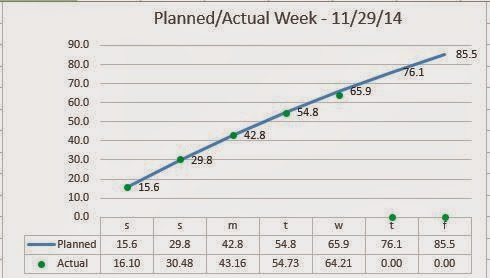
This line graph show the week to date goal for each day of the week. The green dots show the actual miles walked.

At the end of the day, the green dot should be on the line. The distance walked during the day is adjusted to make this happen. Any variance should be small or it impacts the fatigue level.


If the green dot is not on the line, the walker should adjust the miles walked the next day to put the green dot on the line. 

Excess capacity

In order to make this work, the goal MUST lower than the walker's ability. If it's not, eventually a random event will happen that makes catching up impossible.

Conclusion

Random events are catastrophic for those who don't expect them. Front-loading the miles at the beginning of the week results in excess capacity for the remaining days. These days with excess capacity can be used to make up lost miles. Fast enough with consistency is better than faster without consistency.

In a future post, I'll explain how a single week plan is the building block for walk lasting many weeks.